


Peptide Storage Guide for Laboratory Research
Appropriate storage is an important part of maintaining the integrity, stability, and traceability of peptide research materials.
Peptide stability can be influenced by factors including temperature, moisture, light exposure, formulation, oxygen, and repeated environmental changes.
This guide provides general laboratory storage considerations for research peptides. Researchers should always refer to compound-specific documentation, analytical information, published literature, and their own laboratory procedures.
Why Peptide Storage Matters
Peptides can be sensitive to environmental conditions.
Factors that may influence stability include:
- Temperature
- Moisture
- Light exposure
- Oxygen
- pH
- Formulation
- Storage duration
- Repeated temperature changes
Poor storage conditions may affect the characteristics of research materials and introduce unnecessary variability into laboratory work.
General Laboratory Storage Considerations
Research peptides should generally be stored in a controlled environment appropriate to the specific compound and formulation.
Good laboratory practice may include:
- Protecting materials from unnecessary light exposure
- Minimising moisture exposure
- Maintaining consistent storage temperatures
- Avoiding unnecessary temperature cycling
- Keeping containers appropriately sealed
- Recording relevant storage conditions
- Following batch-specific documentation
Storage requirements should be determined using the documentation associated with the relevant research material.
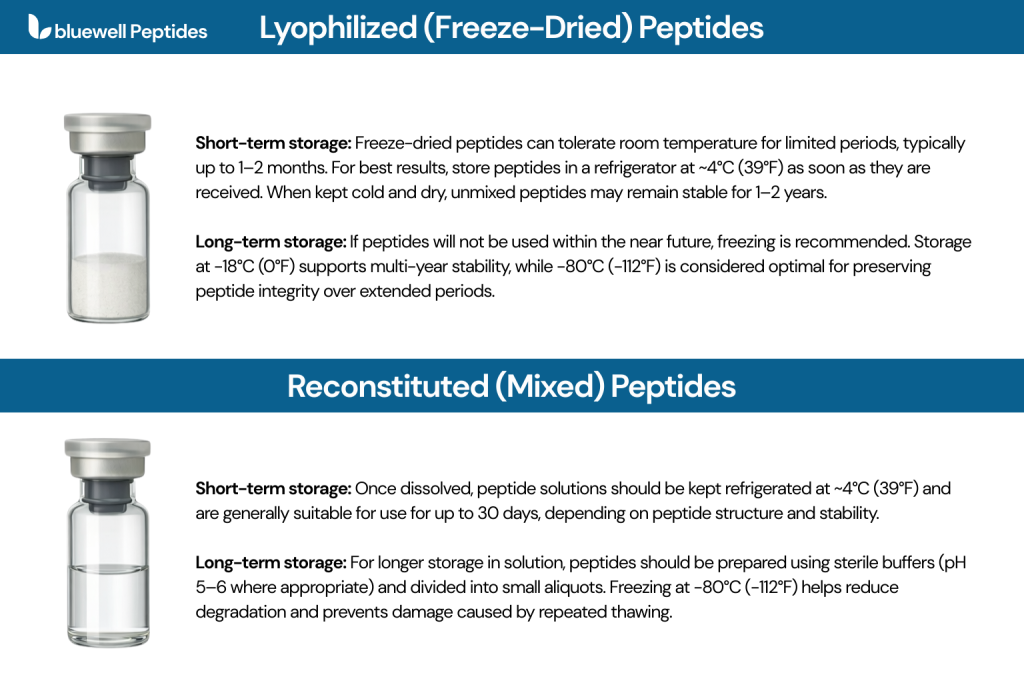
Lyophilised Research Peptides
Lyophilisation is commonly used to support the stability and storage of laboratory materials.
Lyophilised peptides should be protected from unnecessary exposure to:
- Moisture
- Heat
- Direct light
- Repeated environmental changes
Refrigerated or frozen storage may be appropriate depending on the individual compound and associated documentation.
Researchers should avoid applying a single storage duration or temperature recommendation to all peptides, as stability characteristics can vary between materials.
Long-Term Laboratory Storage
Where longer-term storage is required, controlled frozen storage may be used where appropriate for the particular research material.
Researchers should consider:
- Compound-specific stability information
- Manufacturer documentation
- Batch documentation
- Laboratory SOPs
- Temperature monitoring
- Container integrity
Research materials should be clearly labelled and appropriately documented throughout storage.
Peptides in Laboratory Solution
The stability characteristics of a peptide can change once it is incorporated into a laboratory solution.
Relevant considerations may include:
- Solvent or buffer composition
- pH
- Temperature
- Light exposure
- Storage duration
- Container type
- Experimental requirements
Because these factors vary significantly between compounds and research protocols, Bluewell Peptides does not provide universal preparation or administration instructions.
Researchers should follow validated laboratory methods, published scientific literature, and applicable institutional procedures.
Preventing Moisture and Oxidative Exposure
Moisture and oxygen can influence the stability of some peptide materials.
Appropriate laboratory handling may include:
- Keeping containers securely closed when not in use
- Minimising unnecessary exposure to ambient conditions
- Avoiding condensation
- Following appropriate temperature-equilibration procedures
- Maintaining suitable storage documentation
Some peptide sequences may be more susceptible to oxidation than others depending on their amino-acid composition and formulation.
Storage Containers
Appropriate laboratory containers should be compatible with the research material being stored.
Common considerations include:
- Chemical compatibility
- Container integrity
- Moisture protection
- Light protection where required
- Appropriate sealing
- Clear batch identification
The most appropriate container will depend on the peptide, formulation, research protocol, and storage conditions.
Batch Traceability and Storage Records
Storage documentation is an important part of laboratory traceability.
Researchers may wish to record:
- Product name
- Batch number
- Storage location
- Storage temperature
- Date received
- Relevant analytical documentation
- Any observed storage deviations
Clear records can help support reproducibility and appropriate management of research materials.
Key Laboratory Storage Principles
When storing research peptides, laboratories should prioritise:
- Consistent environmental conditions
- Appropriate temperature control
- Protection from moisture and light
- Clear batch identification
- Suitable containers
- Accurate storage records
- Compound-specific guidance
- Established laboratory procedures
Final Thoughts
There is no single storage protocol that applies universally to every peptide.
Storage conditions should reflect the characteristics of the individual compound, relevant analytical documentation, published scientific information, and established laboratory procedures.
Bluewell Peptides provides research materials for laboratory use and does not provide human or veterinary administration guidance.
For Research Use Only. Not for Human or Veterinary Use.